Make Your Library theAI Front Door for the Whole Community
Libraries are already digital resource hubs, makerspaces, and wellness centers. Because they are trusted, neutral, and free, they are the one institution positioned to keep every resident on the right side of the AI divide.
Get the AI Literacy Blueprint
The full Clayton County playbook: pillars, demographic matrix, and the 36-month rollout.

How can AI serve your patrons?
Name a group your library serves. You'll get five program ideas you could actually run — plus a prompt to build a simple companion app.
Want to go deeper? Explore our community resources.
Learn the CRAFT prompting framework, copy ready-to-use prompts, and start building with AI in our live community training hub.
Watch: AI & Your Library
Five short videos on why libraries are the right venue for community AI literacy — and what's at stake if the gap goes unaddressed.
How Libraries Bring AI to Everyone
Closing the AI Divide: A Library Operator Framework
The AI Divide: A Second Chance
The AI Divide: From Information Repository to Innovation Lab
The Explainer: The AI Blueprint for Public Libraries
Community AI Innovation Labs — Presentation Deck
The slide deck for presenting AI programming to your board, council, or leadership team. Download and make it your own.
Why AI Literacy Cannot Wait
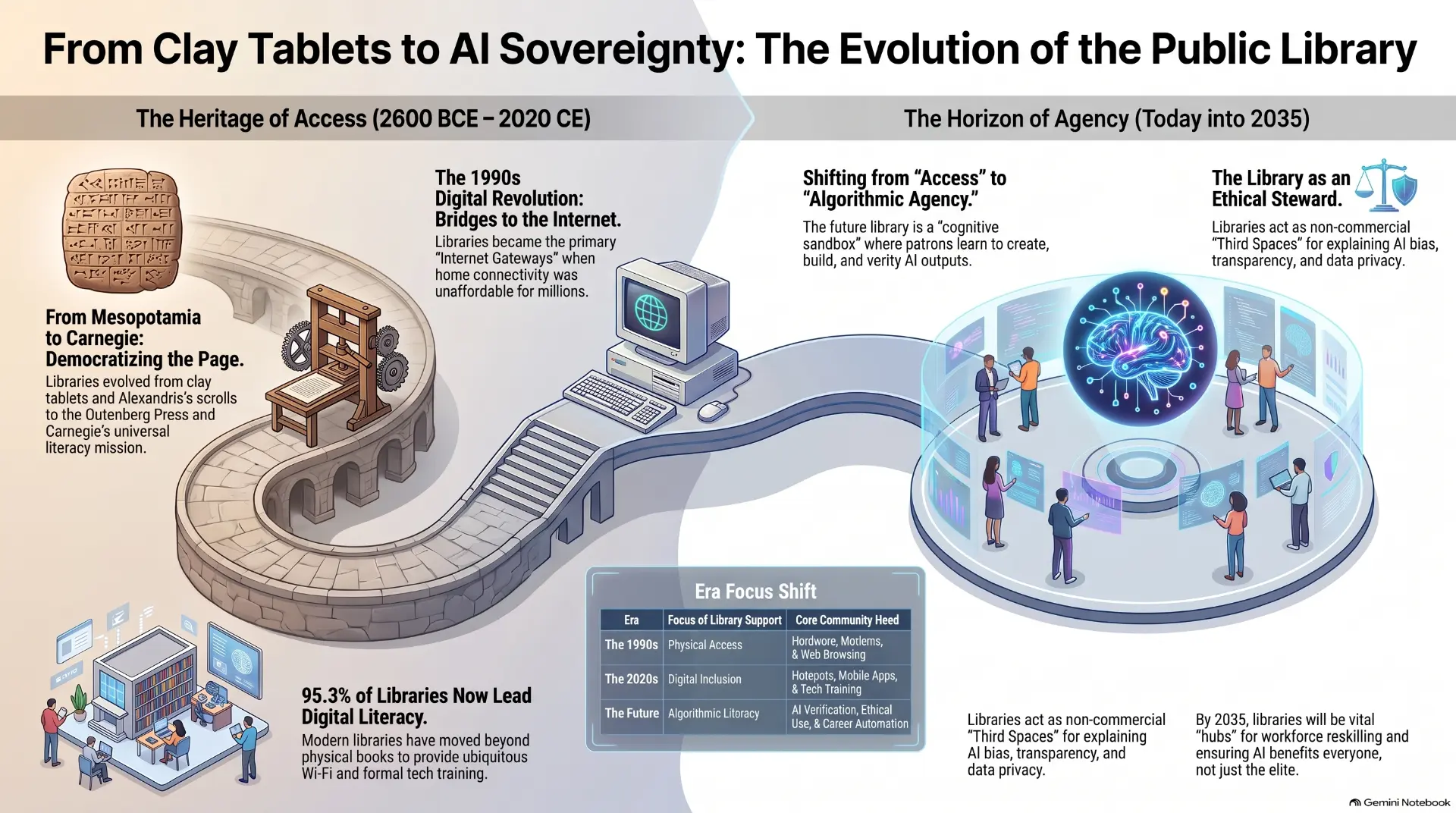
In the mid-1990s, institutional inertia let technological segregation entrench itself — and those inequalities persist thirty years later. AI is projected to be a $4.8 trillion global market by 2033. There is a 24–36 month window before the AI divide becomes a permanent, structural fixture.
| Metric | The Digital Divide (1995–2000) | The AI Divide (2025–2030) |
|---|---|---|
| Primary Barrier | Personal computers cost $1,000+ ($1,500 common) | Private AI camps cost $2,000/week |
| Adoption Rate | Only 50% of U.S. households had internet by 2000 | Only 1 in 6 people globally use GenAI |
| Wealth Gap | 40+ point access gap between income levels | 10.6 point gap between Global North and South |
| Market Concentration | Fragmented hardware and software providers | 100 companies control 40% of global AI R&D |
| Long-Term Risk | Structural career and educational disadvantage | Permanent "AI income gap" and economic exclusion |
The AI for Everyone Thesis
In an era of AI fear and corporate skepticism, the library's status as a neutral civic anchor is the differentiator. We don't just provide access — we provide a safe harbor that restores agency to patrons overwhelmed by the black box.
Workshops focus on the Human + AI advantage — responsible use, ethics, bias, and privacy — not technical coding.

No Tech Jargon
Plain language instead of "LLM" and "inference." A technical background is never the barrier to entry.
Hands-On Learning
Bring-your-own-device sessions where patrons touch the tools in the room, not in theory.
Live Demos
AI shown in real time so it becomes a practical tool instead of a futuristic mystery.
Judgment-Free Spaces
Curious-but-cautious learners can ask the basic questions without stigma.
AI Inside Services You Already Offer
This is not a new department. It's an upgrade to genealogy desks, makerspaces, and social service programming already running in your branches.
Genealogy & Archiving
- Restore and enhance damaged family photos
- Transcribe oral histories into written memoirs
- Read historical handwriting with AI-powered archive tools
Makerspaces
- "Vibe coding" — build real apps with no code
- AI-generated digital art and music production
- Innovation labs that produce portfolio-ready work
Community & Social Services
- Grant writing and donor communications for local nonprofits
- Document translation for multilingual patrons
- Navigate telehealth and summarize complex health information
Tiered Programming by Demographic
One-size-fits-all is a strategic failure. Each track moves patrons from awareness to work to business, with formats built around real accessibility needs.
Seniors (55+)
Security, independence, and connection
- •Scam protection: spot voice-cloned "grandparent" fraud
- •Memory & legacy: restore photos, transcribe oral histories
- •Health literacy: understand prescriptions and medical apps
Accessibility: Large-print materials, slower pace, hearing-friendly rooms
Students & Young Learners (K–12)
From passive consumers to critical creators
- •AI homework helpers that tutor step-by-step, not do the work
- •STEM & coding clubs: chatbots, game characters, web apps
- •Digital citizenship: "Real or AI?" deepfake and bias games
Accessibility: After-school blocks, family permission, gamified formats
Job Seekers & Career Changers
Employable digital skills, fast
- •Resume labs: reframe a 10-year caregiving gap as project management
- •AI role-play interview simulations with instant feedback
- •AI literacy badges — verified micro-credentials for resumes
Accessibility: Flexible scheduling, virtual attendance, translation services
Entrepreneurs & Small Business
Main Street gets enterprise-grade leverage
- •Business automation: marketing content, bookkeeping, market research
- •Half-day chatbot builds for 24/7 FAQs and bookings
- •Vendor readiness: AI-drafted proposals and automated quotes
Accessibility: After-hours sessions, industry modules, 1-on-1 coaching
Parents & Families
Remove the intimidation factor at home
- •Family AI learning nights: co-write an illustrated storybook
- •Smart parenting tools: meal plans, schedules, budgets
- •Open conversations about digital safety
Accessibility: Evening and weekend formats, childcare-friendly rooms
Veterans & Military Families
Translate service into civilian opportunity
- •Turn military skills into business plans and financial projections
- •Portable AI skills for relocating military spouses
- •Peer-mentored cohorts with hybrid attendance
Accessibility: Peer mentors, hybrid formats, portable certifications
The Digital Navigator Ecosystem
External partners carry the technical training load while the library stays the trusted host. Librarians are trained as guides, not experts — that's the multiplier effect.
Infrastructure Literacy
The basic ability to navigate AI interfaces and manage personal data.
Critical Literacy
Capacity to identify hallucinations, algorithmic bias, and ethical risk.
Civic Literacy
Recognizing how AI reshapes local work, democracy, and the regional economy.
Case Study: The IVMF Partnership
A hybrid workshop with the Institute for Veterans and Military Families — featuring IVMF Ambassador John Thomas and keynote Molly Mahoney — proved specialized engagement works. Participants used vibe coding tools to build real digital assets on the spot, skipping traditional coding entirely and moving straight to execution.
The Three-Phase Implementation Roadmap
Sustainability requires moving from one-off events to core infrastructure. This phased rollout aligns with municipal budget cycles.
- Bandwidth mapping against federal standards for high-compute tools
- Staff comfort surveys to identify internal AI champions
- Navigator mapping: local and national curriculum partners
- Launch AI Homework Helpers and Job-Seeker AI Labs
- Finalize human-supervised policies on patron data and transparency
- Monthly staff show-and-tell labs on wins and failures
- Embed AI literacy into every program, from storytime to business workshops
- Stand up permanent AI Readiness Labs for entrepreneurs and veterans
- Package results as the blueprint for regional expansion
Funding, Certification & Institutional Growth
To secure long-term funding, report impact instead of attendance. City councils need data on how AI programs contribute to local economic health and wage growth.
Libraries issue Confidence Markers — the "AI for Everyone: Community Literacy Certificate." These aren't participation trophies; they're evidence of AI readiness and hard data for grant reporting.
The 3-Sentence Council Pitch
A beginner-friendly program providing hands-on AI training for job seekers, seniors, and small businesses.
AI is reshaping a $4.8 trillion global market, and early literacy ensures residents capture those gains instead of falling into an income gap.
Participants walk away with Confidence Markers and practical skills that drive local economic growth and digital equity.
Library Administrator Questions
Do library staff need to become AI experts to run this?
No. The Digital Navigator model puts external partners on the floor for technical instruction while librarians act as trusted guides. Staff are trained to facilitate, not to be experts, which removes the training debt that stalls most programs.
What does an AI for Everyone library program cost to start?
Phase 1 requires no new technology spend. It is a bandwidth audit, a staff comfort survey, and a partner map. Most systems pilot with existing meeting rooms, patron devices, and free-tier AI tools before requesting budget.
How do we prove impact to a city council or grant funder?
Report outcomes, not attendance. Programs issue Confidence Markers such as the AI for Everyone Community Literacy Certificate, producing hard completion data tied to job readiness, small business growth, and digital equity goals.
Is AI safe to teach in a public, all-ages setting?
Yes, under a human-supervised framework. Every session covers responsible use: no sensitive personal data, verification of important answers, and AI as a partner to human judgment rather than a replacement for it.
We Saw This Movie in 1995. This Time We Have No Excuse.
There's a 2–3 year window before the divide becomes permanent. Let's make your community the example of the solution, not the problem.